
Learn how to submit a short film to festivals. Discover submission platforms, eligibility rules, fees, premiere requirements, screeners, deadlines, and tips to improve your chances of selection.
How to Submit a Short Film to Festivals: A Complete Step-by-Step Guide
Completing a short film is a major achievement, but getting it in front of an audience is another important part of the filmmaking journey. Film festivals provide opportunities to showcase your work, connect with industry professionals, receive recognition, meet other filmmakers, and potentially attract distributors, producers, and collaborators.
However, submitting a short film successfully involves more than uploading a video and paying an entry fee. Every festival has its own eligibility rules, submission deadlines, runtime limits, premiere requirements, technical specifications, and selection criteria.
A film that qualifies for one festival may be ineligible for another. How to Submit a Short Film to Festivals: Some festivals welcome films that have already appeared online, while others require premiere status or prohibit public internet screenings before the event.
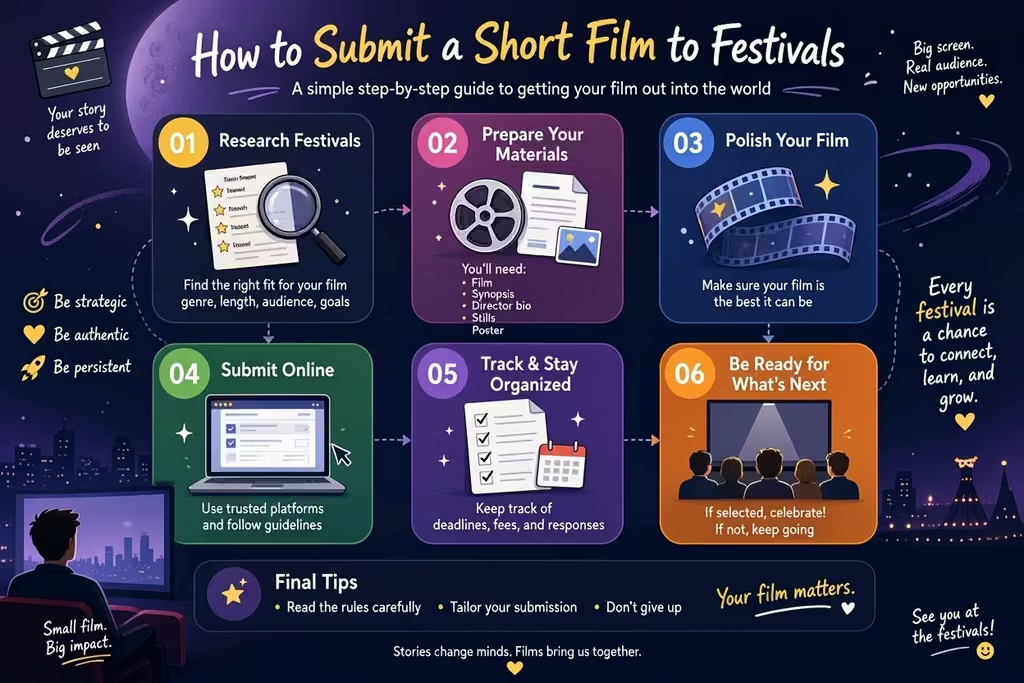
This guide explains how to submit a short film to festivals, from preparing your film and selecting the right events to completing online applications, managing submissions, and delivering your film after acceptance.
Whether you are an independent filmmaker, film student, first-time director, animator, or documentary creator, these practical steps will help you build a more organized festival submission strategy.
Quick Facts: How to Submit a Short Film to Festivals Submissions
| Item | What Filmmakers Should Know |
|---|---|
| Submission method | Online platforms or official festival websites |
| Popular submission platform | FilmFreeway |
| Other submission options | Festhome, Shortfilmdepot, and direct festival portals |
| Film categories | Narrative, documentary, animation, experimental, student, and genre shorts |
| Runtime | Depends on the festival and category |
| Screening copy | Usually a private online screener |
| Common materials | Film file, poster, synopsis, director biography, stills, and credits |
| Subtitles | Often required for films in languages different from the festival’s screening language |
| Submission fee | Varies; some festivals offer free submissions or fee waivers |
| Selection process | Festival programmers or selection committees review eligible entries |
| After selection | Filmmakers may need to provide a final master, DCP, captions, publicity materials, and screening permissions |
Important: There is no universal short-film runtime, submission fee, deadline, or eligibility rule. How to Submit a Short Film to Festivals: Always read the current regulations published by the festival itself.
1. Complete and Finalize Your Short Film
Before searching for festivals, make sure your film is ready for professional screening. How to Submit a Short Film to Festivals: A strong story and creative execution matter, but technical problems can affect the viewing experience and may make a submission difficult to evaluate.
Finalize the picture edit
Review your film from beginning to end. Check the following:
- The opening establishes the story or central idea clearly.
- The editing feels intentional and consistent.
- There are no accidental black frames, missing shots, or unfinished transitions.
- The ending feels complete and appropriate.
- The credits are accurate and readable.
- The total runtime meets the requirements of your target festivals.
Do not assume that a film’s advertised runtime and its final submission runtime are identical. Some festivals count opening and closing credits as part of the total duration.
Check sound quality
Audio is just as important as the image. Before submission:
- Remove unwanted background noise where possible.
- Check dialogue clarity and volume consistency.
- Balance music, sound effects, and dialogue.
- Confirm that the soundtrack does not contain unauthorized copyrighted material.
- Listen to the film using headphones and speakers.
Export a high-quality screening copy
Create a reliable digital screening version. MP4 with H.264 encoding is a widely compatible option for online screeners, but always follow the festival’s technical instructions.
Keep a high-quality master file separately. If your film is selected, the festival may request a different format or a Digital Cinema Package (DCP).
Recommended practice: Maintain at least two versions of your film:
- A high-quality master for archival and exhibition purposes.
- A compressed screening copy for online festival submissions.
2. Research and Choose the Right Film Festivals
One of the most important decisions is choosing festivals that genuinely fit your film. Submitting to every available festival is rarely a good strategy. How to Submit a Short Film to Festivals: Instead, identify events whose programming history, audience, genre preferences, location, and eligibility requirements match your project.
Types of short film festivals
| Festival Type | Best For |
|---|---|
| International film festivals | Films seeking international recognition and exposure |
| Independent film festivals | Independent productions and emerging filmmakers |
| Short-film festivals | Films specifically created for short-form storytelling |
| Documentary festivals | Non-fiction and real-world storytelling |
| Animation festivals | 2D, 3D, stop-motion, and experimental animation |
| Horror and genre festivals | Horror, thriller, science fiction, and fantasy shorts |
| Student film festivals | University, film-school, and student productions |
| Regional film festivals | Filmmakers seeking audiences in a particular country or region |
| Experimental film festivals | Avant-garde, abstract, and unconventional filmmaking |
Research a festival before submitting
Do not rely only on a festival’s promotional description. Visit its official website and review previous editions.
Look for:
- Films selected in previous years.
- Genres and storytelling styles represented.
- Average runtime of selected short films.
- Country and language requirements.
- Premiere and online-release policies.
- Submission deadlines and fees.
- Whether the event screens films physically, online, or in a hybrid format.
- Whether it offers awards, filmmaker networking, industry meetings, or distribution opportunities.
A festival that regularly programs experimental animation may not be the best target for a conventional romantic drama. Similarly, a student-focused festival may have eligibility restrictions that exclude independent professional productions.
Build a shortlist
Create three groups for your submission campaign:
Group A: Priority festivals
These are established or highly relevant festivals that closely match your film’s style, subject, and ambitions.
Group B: Strong-fit festivals
These events have a suitable audience, credible programming history, and realistic eligibility requirements.
Group C: Regional and specialist festivals
These festivals may offer valuable opportunities for local recognition, genre audiences, student filmmakers, or specific cultural communities.
This approach helps you manage your budget while reaching the audiences most likely to appreciate your work.
3. Understand Festival Eligibility Rules
Never submit a film without checking whether it meets the festival’s eligibility requirements. Eligibility rules vary significantly. How to Submit a Short Film to Festivals: A festival may consider a film’s completion date, runtime, production country, premiere status, language, online availability, or previous festival screenings.
Runtime requirements
There is no single worldwide definition of a short film.
Different festivals establish their own limits. For example, the Berlinale Shorts section accepts films up to 30 minutes, while AFI FEST’s published 2026 submission guidance accepts short films of 40 minutes or less.
Some festivals have separate categories for micro-shorts, student films, animated films, or short documentaries.
Check the exact runtime limit for the category you intend to enter.
Completion date
Some festivals only accept films completed within a specified period before the festival takes place.
For example, a festival may require that a film be completed after a particular date. Older films may therefore be ineligible even if they have never been screened publicly.
Premiere status
Premiere status describes whether a film has previously been shown in a particular location or context.
Common terms include:
- World Premiere: The film has not previously been publicly screened anywhere.
- International Premiere: The film has not previously been screened outside its country of origin.
- European Premiere: The film has not previously been screened in Europe.
- National Premiere: The film has not previously been screened in the relevant country.
- Regional Premiere: The film has not previously been screened in a specified region.
- Local Premiere: The film has not previously been screened in the festival’s local area.
Not every festival requires a premiere. Some accept films that have already screened at other festivals or appeared online.
Online availability
Publicly uploading your film to YouTube, Vimeo, or another streaming platform can affect eligibility at festivals that require an online premiere restriction or an unseen film.
However, policies differ. Some festivals accept publicly available films, while others restrict public internet screenings.
For example, AFI FEST’s 2026 guidance states that its short-film submissions have no geographic premiere requirement and may be eligible regardless of online availability. The Cannes Short Film Competition has historically applied much stricter conditions, including restrictions on internet screenings.
Practical advice: If you are targeting premiere-sensitive festivals, avoid making your film publicly available online until you have checked the relevant regulations and planned your release strategy.
4. Create a Film Festival Submission Package
A professional submission package helps festivals understand your project quickly and gives them accurate information for their selection process. How to Submit a Short Film to Festivals: Prepare these materials before opening multiple festival applications.
Essential submission materials
| Material | Purpose |
|---|---|
| Final film or screening link | Allows the selection committee to watch your film |
| Film title | Official title used in festival records |
| Logline | One or two sentences describing the central story |
| Short synopsis | A concise explanation of the film |
| Long synopsis | A more detailed description, when requested |
| Director’s biography | Introduces the filmmaker |
| Director’s statement | Explains the creative motivation and vision |
| Film poster | Provides the main promotional artwork |
| Film stills | Gives festivals images for publicity and catalogues |
| Production credits | Identifies the cast and crew |
| Runtime | States the complete duration, including credits |
| Completion date | Confirms when the film was finished |
| Country of production | Identifies the film’s production origin |
| Language and subtitles | Helps festivals understand screening requirements |
| Contact information | Allows programmers to reach the filmmaker |
Write an effective logline
A logline is a short description that communicates the central concept of your film.
It should usually explain:
- Who the main character is.
- What the character wants or faces.
- What creates the central conflict.
- What makes the story distinctive.
Example:
“After discovering an abandoned photograph in her father’s house, a young woman begins investigating a family secret that changes her understanding of childhood.”
This example introduces a character, a discovery, and a story question without revealing the ending.
Write a concise film synopsis
Your synopsis should communicate the film’s premise, central conflict, and emotional direction.
Avoid unnecessary background information, long character biographies, or promotional language that does not explain the story.
Example structure:
- Introduce the protagonist.
- Explain the situation or central problem.
- Describe the main conflict.
- Establish the stakes without revealing unnecessary spoilers.
Some festivals request both short and long synopses. Prepare versions of different lengths so you can respond to their forms without rewriting the description each time.
Prepare a director’s statement
A director’s statement explains why you made the film and what you wanted to communicate.
Consider addressing:
- What inspired the story?
- Why is the subject important to you?
- What creative approach did you take?
- What should audiences consider after watching?
- What challenges influenced the filmmaking process?
Keep the statement personal, specific, and honest.
Design a professional film poster
Your poster should clearly display the film title and communicate its visual identity.
Use a high-resolution image and check that all text is readable at smaller sizes.
A good poster should not contain misleading festival laurels, awards, or selection claims. Only use official laurels for recognitions the film has actually received.
5. Choose a Film Festival Submission Platform
Online submission platforms allow filmmakers to discover festivals, upload projects, and manage applications. Some festivals also operate their own official submission portals. How to Submit a Short Film to Festivals: The platform you use depends on the event’s requirements.
Popular film festival submission platforms
| Platform | Main Purpose | Useful For |
|---|---|---|
| FilmFreeway | Discover festivals and submit projects online | Independent filmmakers and short-film creators |
| Festhome | Film festival submissions and project management | International festival applications |
| Shortfilmdepot | Short-film registration and festival submission services | Short-film-focused festival circuits |
| Official festival websites | Direct submission through the festival’s own portal | Festivals with independent registration systems |
FilmFreeway: A popular option for short-film submissions
FilmFreeway is one of the most widely used platforms for film festival submissions.
Its basic process is straightforward:
- Visit FilmFreeway.
- Create a filmmaker account.
- Add a new film project.
- Enter the film’s details.
- Upload the screening copy or provide an accepted video link.
- Add the poster and supporting materials.
- Browse festivals.
- Review each festival’s requirements.
- Select the appropriate category.
- Submit the project and complete payment, if required.
After submission, filmmakers can use the platform to track application status and receive festival notifications.
Official platform: FilmFreeway
How to create a professional FilmFreeway project
Your project profile should be complete and accurate.
Include:
- Correct film title.
- Full runtime.
- Completion date.
- Production country.
- Film category and genre.
- Language.
- Synopsis and logline.
- Director and production credits.
- Poster and still images.
- Secure screening link or uploaded video.
- Password, if required.
Before submitting, test your screener using a different device or browser. Make sure the link works and the password is correct.
Do all festivals use FilmFreeway?
No. Some festivals accept entries through FilmFreeway, while others use their own websites or different submission services.
For example, the Berlinale has its own online film registration and media-upload process. Always follow the submission instructions on the official festival website rather than assuming that every event uses the same platform.
6. Prepare a Secure Online Film Screener
A screener is the version of your film provided to the selection committee for private review. How to Submit a Short Film to Festivals: It should play reliably and represent the film accurately.
Common screener options
You may be asked to provide:
- A video uploaded directly to a submission platform.
- A private Vimeo link.
- A password-protected online screening link.
- A file uploaded through the festival’s official portal.
Some festivals accept only specific methods, so follow their instructions.
Screener checklist
Before submitting your film:
- Test the video on a desktop and mobile device.
- Check that the film plays from beginning to end.
- Confirm that the image and audio are synchronized.
- Make sure the password is correct.
- Confirm that the link does not expire before the selection period ends.
- Check whether downloads must be disabled.
- Ensure that subtitles are visible and synchronized.
- Confirm that the festival has permission to access the screener.
Do not change the screening password or remove the video while festivals are reviewing your application unless you have updated the relevant submission records.
7. Understand Film Festival Submission Fees
Many film festivals charge entry fees to cover administrative and programming expenses. How to Submit a Short Film to Festivals: However, not every festival charges filmmakers. The cost may depend on the festival, submission category, deadline, and filmmaker eligibility.
Common submission fee structures
| Submission Period | General Explanation |
|---|---|
| Early Bird | Usually the earliest and lowest-priced submission period |
| Regular | Standard entry period |
| Late | Later submission period, often with a higher fee |
| Extended | An additional deadline, if offered |
| Waiver | A reduction or exemption from the entry fee |
These are common structures, not universal requirements. A festival may use different deadline names or charge the same fee throughout its submission period.
How to manage your submission budget
Before submitting, calculate the total cost of your festival campaign.
For example, if you enter 15 festivals, your total expense includes more than the entry fees. You may also need to budget for:
- Film poster design.
- Subtitles and translation.
- DCP creation.
- Travel and accommodation.
- Publicity and promotional materials.
- Screening copies and delivery costs.
Set a budget before submitting and prioritize festivals that offer a genuine audience or professional opportunity for your film.
Can you submit a short film for free?
Yes. Some festivals offer free submission periods, student discounts, fee waivers, or no-cost entry categories.
To find these opportunities:
- Search for festivals with free submission options.
- Check official festival websites.
- Look for student or emerging-filmmaker programmes.
- Review waiver policies on submission platforms.
- Contact the festival if you have a legitimate financial hardship or eligibility question.
Never assume a festival will provide a waiver. Confirm the policy before submitting.
8. Submit Your Short Film: Step-by-Step Process
Once your film, materials, and festival shortlist are ready, you can begin submitting. How to Submit a Short Film to Festivals: The following workflow works for many online submission systems, although individual festivals may have different procedures.
Step 1: Select the correct festival
Choose a festival that matches your film’s genre, runtime, production background, and audience.
Read the latest submission regulations before proceeding.
Step 2: Select the correct category
Many festivals offer separate categories for:
- Narrative short films.
- Documentary short films.
- Animated short films.
- Student films.
- Experimental films.
- International short films.
- Horror and genre films.
Choose the category that accurately represents your project. Do not enter a film into a category simply because it appears more competitive or offers a different award.
Step 3: Complete the application form
Enter the requested information carefully.
Check spelling, film credits, production dates, contact details, and runtime.
Make sure the information matches your official project profile and supporting documents.
Step 4: Upload the screener
Upload the film or provide the accepted private screening link.
Check that the selection committee can access the video without requesting additional permissions.
Step 5: Upload supporting materials
Provide the poster, synopsis, director biography, stills, and other requested materials.
Do not send unnecessary attachments if the festival has not requested them.
Step 6: Confirm eligibility and permissions
Review the festival’s rules concerning:
- Premiere status.
- Online availability.
- Copyright ownership.
- Music and archival footage.
- Screening rights.
- Promotional use of film excerpts and stills.
- Data and privacy policies.
Only agree to terms you understand and have authority to accept.
Step 7: Pay the entry fee, if applicable
Complete payment through the official submission platform or festival portal.
Check the amount and currency before confirming the transaction.
Step 8: Save your confirmation
After submitting, save:
- Submission confirmation.
- Festival name.
- Submission date.
- Entry category.
- Fee paid.
- Submission ID or reference number.
- Notification date.
- Screening-link details.
This information will help you manage your festival campaign.
9. Understand Film Festival Deadlines and Notification Dates
Film festivals often use multiple submission deadlines. How to Submit a Short Film to Festivals: Submitting early can help you avoid last-minute technical problems and may reduce the entry fee.
Build a festival submission calendar
Create a spreadsheet or tracking document with these columns:
| Festival | Country | Category | Deadline | Fee | Submission Date | Notification Date | Status |
|---|---|---|---|---|---|---|---|
| Festival A | France | International Short | Check official site | Varies | Not submitted | Check official site | Research |
| Festival B | USA | Narrative Short | Check official site | Varies | Not submitted | Check official site | Research |
| Festival C | India | Short Film | Check official site | Varies | Not submitted | Check official site | Research |
| Festival D | Germany | Documentary Short | Check official site | Varies | Not submitted | Check official site | Research |
These are sample tracking entries, not confirmed open calls or current deadlines.
Why early submission is useful
Submitting early may help you:
- Access lower entry fees.
- Avoid application rushes.
- Correct mistakes before the deadline.
- Plan around premiere restrictions.
- Organize your next submission opportunities.
However, an early submission does not guarantee selection. Festivals may review entries according to their own programming schedules.
10. Improve Your Chances of Getting Selected
No submission method can guarantee acceptance. How to Submit a Short Film to Festivals: Festival programmers consider creative quality, originality, technical execution, programme balance, eligibility, and the overall direction of the event.
Nevertheless, filmmakers can make their submissions more professional and strategically focused.
Tell a compelling story
A short film has limited time to establish characters, conflict, atmosphere, and emotional impact.
Make every scene contribute to the story.
Avoid unnecessary dialogue, confusing exposition, and scenes that do not advance the narrative or creative purpose.
Make the opening engaging
The first moments should establish a reason for the audience to continue watching.
This does not mean every film needs an action-packed opening. A quiet, experimental, or atmospheric film can also create a strong beginning through compelling images, sound, tension, or character detail.
Pay attention to sound and editing
A technically polished film is easier to evaluate and screen.
Review the final mix, dialogue, sound effects, subtitles, colour consistency, and pacing before submission.
Target festivals that fit your film
A horror short may be more suitable for a genre festival than a general event whose programming rarely includes horror.
Likewise, a student animation may benefit from a festival with a dedicated student or animation programme.
Research previous selections to understand the festival’s programming interests.
Prepare a professional submission package
Your synopsis, poster, stills, and director’s statement should communicate the film clearly.
A complete and accurate application makes the programmer’s evaluation easier and reduces unnecessary follow-up questions.
Follow the festival rules
Do not hide previous screenings, provide an inaccurate runtime, or claim a premiere status your film does not have.
Accurate information protects your eligibility and professional reputation.
Do not rely on awards alone
Awards and festival selections can help establish credibility, but a film should not be submitted only because a festival advertises a large number of awards.
Look at the event’s programming quality, reputation, audience, and relevance to your creative goals.
11. What Happens After You Submit Your Film?
After submission, the festival typically reviews the application and screening copy. How to Submit a Short Film to Festivals: The selection process may take several weeks or months, depending on the festival’s schedule and submission volume.
Common submission statuses
| Status | Meaning |
|---|---|
| Submitted | The application has been sent |
| Received | The festival has received the entry |
| In Consideration | The film is being reviewed or considered |
| Under Review | The application is in the review process |
| Official Selection | The film has been selected for the festival programme |
| Finalist | The film has reached a finalist stage, if the festival uses this status |
| Award Winner | The film has received an award |
| Not Selected | The film was not included in the programme |
| Withdrawn | The filmmaker or festival has withdrawn the entry |
Status labels differ across platforms and festivals. A status such as “In Consideration” does not necessarily mean that the film has reached a final selection stage.
If your film is selected
Congratulations! The next step is to follow the festival’s instructions.
You may be asked to provide:
- A high-resolution exhibition master.
- A DCP.
- English or local-language subtitles.
- Closed captions or accessibility materials.
- A final synopsis and director biography.
- High-resolution poster artwork.
- Production stills.
- Trailer or promotional clips.
- Screening permissions and delivery forms.
Read the acceptance agreement carefully. Confirm the screening date, format, technical requirements, publicity permissions, and any travel or attendance arrangements.
If your film is not selected
Rejection is a normal part of festival submissions. Even strong films cannot fit into every programme.
Consider the following steps:
- Keep the film available for other eligible festivals.
- Review whether your next target festivals have different programming interests.
- Check that your film remains eligible under their rules.
- Improve your promotional materials if necessary.
- Continue developing your next project.
Do not assume that a rejection means the film lacks quality. Festivals have limited screening slots and different artistic priorities.
12. What to Do About Premiere Status and Online Release
A filmmaker’s release strategy can affect which festivals are available. How to Submit a Short Film to Festivals: If your goal is to enter premiere-sensitive festivals, plan the order of submissions before publishing the film online.
A practical release strategy
Stage 1: Research
Identify festivals that require premiere status and confirm their current rules.
Stage 2: Priority submissions
Submit to the festivals that matter most to your film’s goals and eligibility.
Stage 3: Festival screening period
Keep track of selection notifications, screening dates, and any restrictions on public availability.
Stage 4: Wider festival submissions
After your premiere-sensitive opportunities have passed, submit to additional festivals that accept previously screened films.
Stage 5: Online release
When your festival strategy allows, publish your film on an appropriate platform and promote it to a wider audience.
This is only a planning framework. The correct sequence depends on each festival’s rules, your film’s release history, and any agreements you have signed.
13. Important Technical Requirements for Festival Screenings
An online screener and a festival exhibition file are not always the same thing. How to Submit a Short Film to Festivals: A festival may initially review a compressed online video but request a different delivery format after selection.
Common exhibition requirements
| Requirement | What It Means |
|---|---|
| DCP | Digital Cinema Package used for many theatrical screenings |
| ProRes master | High-quality video file often requested for exhibition or conversion |
| H.264 MP4 | Common format for online screeners |
| Resolution | The image dimensions, such as 1920 × 1080 |
| Frame rate | The number of frames displayed per second |
| Audio channels | Stereo or surround-sound configuration |
| Subtitles | Translated dialogue or on-screen text |
| Closed captions | Captions that include relevant spoken dialogue and sound information |
| Audio description | A narration track describing important visual information |
These are examples, not a universal festival specification. How to Submit a Short Film to Festivals: Always request or download the festival’s latest technical delivery document.
Create a DCP when required
A Digital Cinema Package is a standardized format used for digital cinema exhibition. Do not create a DCP simply because you are submitting to a festival. Wait until you understand the festival’s actual requirements. How to Submit a Short Film to Festivals: If selected, ask the festival whether it accepts a DCP created by the filmmaker, provides a conversion service, or requires a specific delivery workflow.
14. Common Mistakes to Avoid When Submitting Short Films
How to Submit a Short Film to Festivals: Many submission problems are preventable.
| Mistake | Why It Can Be a Problem | Better Approach |
|---|---|---|
| Ignoring eligibility rules | The film may be disqualified | Read the current regulations |
| Submitting to unrelated festivals | Poor audience and programming fit | Research previous selections |
| Incorrect runtime | The film may not qualify | Include all credits in the runtime |
| Broken screener link | Programmers cannot watch the film | Test the link before submitting |
| Incorrect password | Access may be blocked | Verify the password |
| Missing subtitles | The film may be difficult to evaluate | Prepare accurate required subtitles |
| Weak synopsis | The story may be misunderstood | Write a clear and concise description |
| Low-quality poster | Promotional materials look unfinished | Use professional artwork |
| Missing credits | Important contributors may be omitted | Verify the final credit list |
| Publicly releasing too early | Premiere-sensitive eligibility may be affected | Plan the release strategy |
| Entering the wrong category | The film may not fit the programme | Select the accurate category |
| Ignoring notification emails | Important deadlines may be missed | Monitor your contact email |
| Submitting without a budget | Costs can become difficult to control | Set a submission budget |
| Assuming every festival is legitimate | You may waste money or rights | Research the event and its history |
15. How to Identify Legitimate Film Festivals
Not every event advertising itself as an international film festival offers meaningful screening or industry opportunities. How to Submit a Short Film to Festivals: Before paying an entry fee, conduct basic research.
Festival credibility checklist
- Does the festival have an official website?
- Are previous editions documented?
- Can you find past film selections and award winners?
- Are the venue and event dates clearly identified?
- Are the organizers and contact details available?
- Are submission requirements transparent?
- Are entry fees and refund policies explained?
- Are screening arrangements described clearly?
- Are the terms concerning film rights and promotional use understandable?
- Can you find independent information about the event?
Be careful with festivals that make unrealistic promises about guaranteed awards, guaranteed distribution, or guaranteed industry recognition. How to Submit a Short Film to Festivals: A legitimate festival can offer opportunities, but no festival should be treated as a guaranteed route to commercial success.
16. Best Film Festival Submission Strategy for Independent Filmmakers
Independent filmmakers often have limited time and money. How to Submit a Short Film to Festivals: A focused submission campaign can be more effective than submitting randomly.
Build a balanced festival portfolio
Consider dividing your festival targets into three groups:
| Group | Strategy | Objective |
|---|---|---|
| High-priority festivals | Submit to events with strong relevance and recognition | Build visibility and pursue major opportunities |
| Genre and specialist festivals | Target festivals that regularly programme similar films | Reach the right audience |
| Regional and emerging festivals | Enter credible local and independent events | Build screening experience and connections |
Create a submission timeline
A practical timeline could look like this:
Before the first submission
- Finalize the film.
- Prepare the poster and synopsis.
- Create a director’s statement.
- Research premiere requirements.
- Build a shortlist.
During the submission campaign
- Submit before relevant deadlines.
- Track fees and confirmation numbers.
- Keep screening links active.
- Monitor notification dates.
- Update your records when statuses change.
After festival decisions
- Respond promptly to acceptance emails.
- Deliver requested screening materials.
- Confirm promotional information.
- Plan the next festival or online-release stage.
Measure the results
Track more than the number of rejections or awards.
Useful measures include:
- Number of eligible festivals identified.
- Number of completed submissions.
- Total submission expenditure.
- Official selections.
- Festival screenings attended.
- Audience engagement.
- Industry contacts developed.
- Invitations to other events.
- Distribution or collaboration opportunities.
This helps you evaluate whether your submission strategy is supporting your filmmaking goals.
17. Useful Websites for Short Film Festival Submissions
How to Submit a Short Film to Festivals: The following resources can help filmmakers discover festivals and understand official submission requirements.
| Website | What You Can Use It For |
|---|---|
| FilmFreeway | Discover festivals, create film profiles, and submit entries |
| Festhome | Explore film festivals and submission opportunities |
| Shortfilmdepot | Find short-film submission opportunities |
| Festival de Cannes | Review Cannes film submission information |
| Berlinale | Read official film-entry regulations |
| Sundance Film Festival | Check Sundance submission information |
| AFI FEST | Review AFI FEST submission guidance |
| Raindance Film Festival | Understand festival submission policies |
Important: Festival calls, fees, deadlines, and eligibility rules change. How to Submit a Short Film to Festivals: Use these websites to research opportunities, then confirm the latest information on the official festival page before submitting.
18. Short Film Festival Submission Checklist
How to Submit a Short Film to Festivals: Use this checklist before sending your film to any festival.
Film preparation
- The final cut is complete.
- The runtime is accurate, including credits.
- The audio and picture have been checked.
- The screening file plays correctly.
- The film’s music and footage rights have been reviewed.
Submission materials
- Film poster is ready.
- Short synopsis is prepared.
- Long synopsis is available if required.
- Logline is written.
- Director biography is prepared.
- Director’s statement is ready.
- Film stills are available.
- Production credits are accurate.
Festival research
- The festival is relevant to the film.
- The correct category has been selected.
- The runtime limit has been checked.
- The completion-date requirement has been checked.
- Premiere requirements have been reviewed.
- Online availability restrictions have been checked.
- The submission deadline has been confirmed.
- The entry fee and payment currency are known.
Final submission
- The screener link works.
- The password is correct.
- Subtitles are accurate and synchronized.
- The application form has been reviewed.
- Required permissions and terms have been checked.
- Payment has been completed, if required.
- Confirmation details have been saved.
Frequently Asked Questions About Submitting Short Films to Festivals
1. How do I submit a short film to festivals?
First, finalize your film and prepare its poster, synopsis, logline, director biography, and screening copy. Research festivals that match your film, check their eligibility rules, and submit through their accepted platform or official website. Save your confirmation and monitor the festival’s notification schedule.
2. What is the best website to submit short films to festivals?
FilmFreeway is a popular platform for discovering festivals and submitting short films. Festhome and Shortfilmdepot are other options. Some major festivals also operate their own submission portals, so the best platform depends on the festival you want to enter.
3. Can I submit my short film to multiple festivals?
Yes. Filmmakers can generally submit the same short film to multiple festivals, provided it meets each event’s eligibility requirements. However, check premiere restrictions, exclusivity clauses, and any other conditions before entering.
4. How much does it cost to submit a short film to a festival?
There is no fixed submission fee. Some festivals offer free entry, while others charge fees that vary according to the festival, category, and submission period. Check the official submission page before paying.
5. Can I submit a short film to festivals for free?
Yes. Some festivals have free submission options, student programmes, fee waivers, or special no-cost calls. Search the festival’s official website and submission platform for current opportunities.
6. What is the ideal runtime for a short film festival?
There is no universal ideal runtime. Some festivals accept micro-shorts of a few minutes, while others accept films of 30 or 40 minutes. The best runtime is the length that serves your story and meets the rules of your target festivals.
7. Can I submit a short film without a film school background?
Yes. Many festivals welcome independent filmmakers, self-taught creators, professional filmmakers, and students. However, student-only categories may require proof of enrollment or film-school eligibility.
8. Do film festivals accept films that are already on YouTube?
Some do, while others restrict films that have been publicly released online. Check the festival’s current online-availability and premiere policies before uploading your film publicly.
9. Do I need subtitles to submit an international short film?
Many festivals require subtitles when a film is not in the language used by the selection committee or screening audience. English subtitles are commonly requested for international submissions, but some festivals require subtitles in another language. Follow the specific regulations.
10. What file format should I use to submit a short film?
The accepted format depends on the festival. MP4 with H.264 encoding is commonly used for online screeners, but some festivals accept other formats or require a particular upload specification. A selected film may need a high-quality master or DCP for exhibition.
11. What happens if my short film is selected?
The festival normally sends an official selection notification and further instructions. You may need to provide an exhibition copy, DCP, subtitles, captions, promotional stills, director information, and screening permissions.
12. Can I withdraw my short film after submitting it?
This depends on the festival’s regulations and withdrawal policy. Some festivals allow withdrawal requests, while entry fees may be non-refundable. Contact the festival directly and review its terms before submitting.
13. How long does it take for a festival to select a short film?
The selection timeline varies. Some festivals notify filmmakers several weeks before the event, while others take months. Check the published notification date and monitor your email and submission-platform account.
14. Should I submit my short film to major festivals first?
If your film meets their requirements and premiere opportunities are important, it can make sense to prioritize major festivals. However, do not ignore specialist and regional festivals that may be a better programming fit. Build a strategy around eligibility, audience, budget, and your goals.
15. Does submitting a short film transfer copyright to the festival?
Submitting a film does not automatically mean that copyright ownership transfers to the festival. However, submission and acceptance terms may grant specific screening or promotional permissions. Read the applicable terms carefully and make sure you have the authority to grant the requested rights.
Conclusion: Start Your Short Film Festival Journey with a Clear Plan
How to Submit a Short Film to Festivals: Submitting a short film to festivals is an important step in bringing your work to a wider audience. A successful campaign begins with a finished film, a professional submission package, careful festival research, and a clear understanding of eligibility requirements.
Use platforms such as FilmFreeway, Festhome, and Shortfilmdepot to discover opportunities, but always confirm the rules on the official festival website. Pay particular attention to runtime, completion dates, premiere status, online availability, deadlines, entry fees, and technical delivery requirements.
Most importantly, choose festivals that genuinely fit your film. How to Submit a Short Film to Festivals: A focused submission strategy can help independent filmmakers make better use of their time and budget while building meaningful screening and networking opportunities.
Your film deserves to be seen. Prepare it carefully, submit it strategically, and keep creating.