
Learn how to make a short film on a low budget with this step-by-step guide. Discover scriptwriting, equipment, budgeting, filming, editing, and festival submission tips.
How to Make a Short Film on a Low Budget: A Complete Step-by-Step Guide
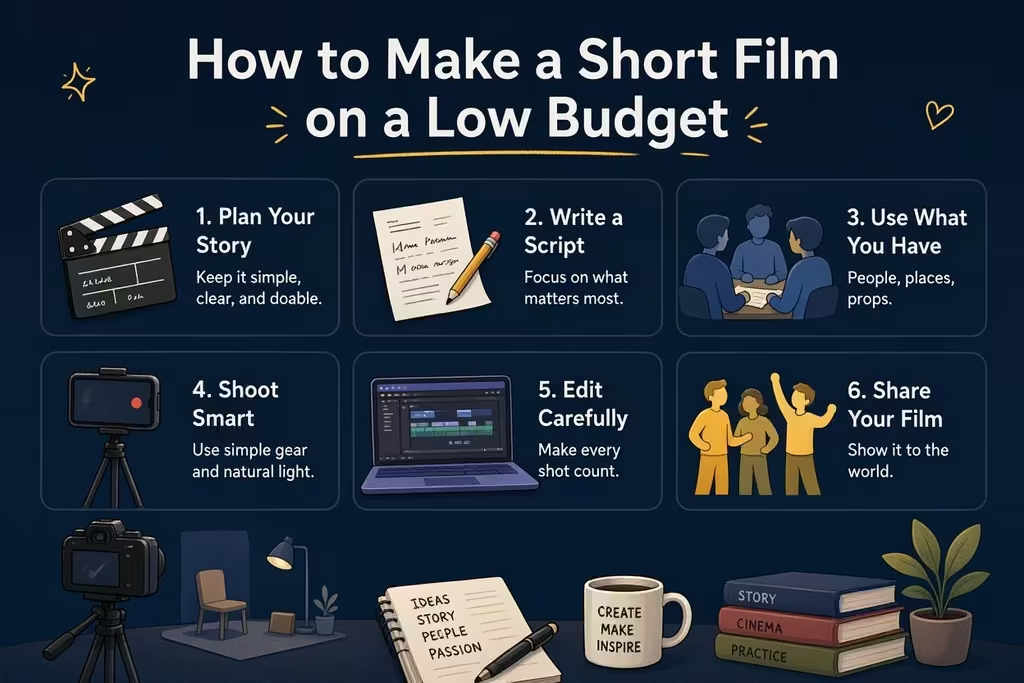
Making a short film does not require an expensive camera, a professional film studio, or a large production team. With a compelling story, careful planning, accessible equipment, and creative problem-solving, independent filmmakers can produce an engaging short film with limited financial resources.
For beginners, short filmmaking is one of the best ways to learn storytelling, directing, cinematography, sound recording, editing, and film production. It also provides an opportunity to develop a creative portfolio, participate in film festivals, and introduce your work to a wider audience.
But how do you make a short film when you have little money?
The secret is to plan around the resources you already have. Instead of trying to reproduce an expensive Hollywood production, develop a story that works with a small cast, manageable locations, simple equipment, and a realistic production schedule.
This guide explains how to make a short film on a low budget, from developing your first idea to writing the screenplay, planning production, filming, editing, and submitting your completed project to film festivals, also read AD Advertising Case Study Examples across technology.
Quick Facts: How to Make a Short Film on a Low Budget
| Element | Practical recommendation |
|---|---|
| Best for | Beginners and independent filmmakers |
| Suggested first-film length | Approximately 3–10 minutes |
| Story structure | One central character and conflict |
| Cast | Small, manageable cast |
| Locations | One or two accessible locations |
| Camera | Smartphone or available camera |
| Essential equipment | Camera, microphone, tripod, lighting |
| Main production stages | Development, pre-production, production, post-production |
| Important priority | Storytelling and clear sound |
| Final objective | A completed, properly exported film |
These are practical starting points rather than mandatory filmmaking rules. How to Make a Short Film on a Low Budget: The right runtime, crew size, and equipment depend on the story and the intended audience.
1. Start with a Strong Short Film Idea
Every successful short film begins with an idea. Before purchasing equipment or searching for actors, decide what story you want to tell.
A short film usually has limited time to introduce its characters, establish a conflict, and create an emotional or intellectual impact. Therefore, a focused story is often more effective than a complicated plot with too many characters and locations.
Start by answering these questions:
- What is the central idea of the film?
- Who is the main character?
- What does the character want?
- What problem prevents the character from achieving that goal?
- What should the audience feel or understand by the ending?
For example, consider a story about a young man who receives a mysterious phone call from someone claiming to be his future self. How to Make a Short Film on a Low Budget: This simple concept can create suspense without requiring expensive locations, complicated visual effects, or a large cast.
Short film ideas for beginners
Here are some ideas that can be developed into low-budget productions:
- The Last Message: A person receives a final message from someone they thought they had lost.
- The Empty Room: A character discovers something unexpected in an abandoned room.
- One Decision: A student must make an important decision before an approaching deadline.
- The Stranger: Two strangers meet during an unusual situation and discover an unexpected connection.
- The Forgotten Photograph: An old photograph reveals a family secret.
- The Final Call: A phone conversation changes someone’s understanding of an important event.
- The Silent Visitor: A mysterious visitor arrives without explaining their purpose.
Choose an idea that can be filmed with the people, locations, and resources available to you.
2. Write a Short Film Script
Once you have selected your idea, develop it into a screenplay.
A screenplay is the foundation of the production process. It describes the scenes, characters, dialogue, actions, and important visual information needed to create the film.
For a beginner’s project, avoid unnecessary subplots and complicated character relationships.
Essential elements of a short film script
- Opening: Introduce the character, setting, and situation.
- Conflict: Establish the problem or challenge that drives the story.
- Development: Show how the character responds to the situation.
- Climax: Present the most important confrontation, discovery, or decision.
- Ending: Deliver a satisfying conclusion, emotional moment, or thought-provoking final image.
How long should a short film script be?
A commonly used screenplay planning estimate is approximately one formatted screenplay page per minute of screen time. How to Make a Short Film on a Low Budget: However, actual runtime depends on dialogue, action, pauses, and visual storytelling.
For a first project, a concise screenplay of around 3–10 pages can be a manageable starting point.
Tips for writing a better short film screenplay
- Introduce the central conflict early.
- Give the main character a clear objective.
- Use dialogue only when it adds something meaningful.
- Communicate information through actions and images.
- Avoid unnecessary characters.
- Keep locations manageable.
- Give the ending a clear emotional or narrative purpose.
Read the screenplay aloud before filming. A simple table read with friends can help identify unnatural dialogue, confusing scenes, and pacing problems.
3. Create a Realistic Short Film Budget
A low-budget film still needs a budget. Even if you use free locations and borrowed equipment, production may involve transportation, food, props, storage, editing, music, and festival expenses.
Create a basic budget before committing to production.
Example low-budget short film budget
How to Make a Short Film on a Low Budget: The following is an illustrative budget in Indian rupees, not a fixed industry production rate.
| Expense | Example budget |
|---|---|
| Script and development | 0–1,000 |
| Travel and transportation | 1,500 |
| Food and refreshments | 1,500 |
| Props and costumes | 1,000 |
| Equipment rental or accessories | 2,000 |
| Location expenses | 1,000 |
| Editing and post-production | 1,500 |
| Contingency | 1,500 |
| Illustrative total | 10,000 |
Your actual budget could be lower or higher depending on the production requirements. How to Make a Short Film on a Low Budget: A film using borrowed equipment, free locations, and volunteer collaborators may cost considerably less.
Where should you spend your money?
Prioritize expenses that directly affect the viewing experience:
- Clear dialogue and sound recording.
- Suitable lighting.
- Reliable storage and backup.
- Essential production requirements.
- Editing and sound finishing.
Avoid spending heavily on decorative equipment or accessories that do not improve the finished film.
A strong screenplay and well-executed performances are generally more valuable than owning an expensive camera.
4. Choose Affordable Filmmaking Equipment
You do not need professional cinema equipment to begin making short films. How to Make a Short Film on a Low Budget: Modern smartphones and entry-level cameras can produce impressive footage when used carefully.
Essential equipment for a low-budget short film
- Camera: Use a smartphone or camera you already own. Learn its focus, exposure, frame-rate, and resolution settings before filming.
- Tripod: A stable tripod helps prevent unwanted camera movement and improves the consistency of your shots.
- Microphone: Clear dialogue is essential. Consider a compatible lavalier or external microphone when possible.
- Lighting: Use natural window light, affordable LED lights, reflectors, and practical lamps.
- Headphones: Monitor sound while recording to identify unwanted background noise.
- Storage: Keep sufficient memory cards or storage space and maintain backup copies of important footage.
Can you make a short film with a smartphone?
Yes. A smartphone can be a practical filmmaking tool, especially for a beginner’s project.
For better results:
- Clean the camera lens.
- Stabilize the phone.
- Lock focus and exposure when appropriate.
- Avoid unnecessary digital zoom.
- Record dialogue in a quiet environment.
- Check lighting before recording.
- Capture multiple takes.
- Review footage during the shoot.
The most important thing is not the price of your equipment but how effectively you use it.
5. Plan Your Short Film Before Shooting
Pre-production is the planning stage before the actual filming begins.
Good preparation reduces production delays, unnecessary expenses, and avoidable mistakes.
Prepare these production documents
- Script: The final screenplay with scene descriptions and dialogue.
- Shot list: A list of the shots required for every scene.
- Storyboard: Simple drawings or visual references showing how important scenes will be filmed.
- Production schedule: A timetable showing when each scene will be recorded.
- Budget: A list of expected production expenses.
- Call sheet: A document communicating the shoot date, location, schedule, and essential contact details to the production team.
- Permission documents: Written permissions and releases where necessary for locations, performers, and other relevant rights.
Why is a shot list important?
A shot list helps the director and cinematographer understand exactly what needs to be filmed.
For example, a simple conversation scene may require:
- Wide shot showing both characters.
- Medium shot of the first character.
- Medium shot of the second character.
- Close-up of the important reaction.
- Additional detail shots when needed.
Planning these shots before production saves time and helps maintain visual continuity.
6. Find Affordable Locations and Actors
Locations and performers can significantly influence a production budget.
For a low-budget short film, consider places that are easily accessible and suitable for the story.
Affordable filming locations
- Your home or apartment.
- A friend’s house with permission.
- A private office or workspace.
- A permitted outdoor location.
- A community hall.
- A classroom or studio with authorization.
- A suitable local business that agrees to filming.
Before filming, check location permissions, noise conditions, lighting, safety, and any restrictions on commercial or public use.
Do not assume that a public place automatically allows unrestricted filming.
How to find actors for a short film
You can find performers through:
- Local theatre groups.
- Film schools and acting communities.
- Independent filmmaking networks.
- Social media casting announcements.
- Friends and creative collaborators.
Select performers based on suitability for the characters, availability, and ability to work with the production schedule.
Discuss compensation, credits, filming dates, and intended distribution before recording. Use appropriate written agreements.
7. Shoot Your Short Film
Production is the stage where your screenplay becomes recorded footage. How to Make a Short Film on a Low Budget: A well-planned shooting day helps you capture all essential scenes while controlling expenses and maintaining creative consistency.
Important filmmaking techniques
- Composition: Arrange subjects and objects within the frame to guide the audience’s attention.
- Camera angles: Use appropriate wide shots, medium shots, close-ups, and other perspectives to support the story.
- Lighting: Make sure the subject is clearly visible and the lighting remains consistent between shots.
- Sound recording: Monitor dialogue, background noise, and microphone placement.
- Continuity: Check costumes, props, actor positions, and scene details between takes.
- Performance: Give actors clear direction and allow enough time for natural performances.
Record more than one take
- Even experienced filmmakers record multiple takes.
- Different performances, camera movements, and shot compositions provide useful choices during editing.
- Review important footage before leaving a location. This can prevent expensive reshoots later.
8. Edit Your Short Film
Post-production begins after the main filming is complete. How to Make a Short Film on a Low Budget: Editing transforms individual clips into a complete story with rhythm, visual continuity, sound, and emotional impact.
Affordable video editing software
Here are some commonly used editing options:
| Software | Best for |
|---|---|
| DaVinci Resolve | Video editing, colour correction, and audio post-production |
| Adobe Premiere Pro | Professional video editing workflow |
| CapCut | Accessible editing for beginners and social video |
| Shotcut | Free, open-source video editing |
| Kdenlive | Free, open-source editing for desktop workflows |
Check current software features, system requirements, licensing, and export limitations before choosing a tool.
Main stages of short film editing
- Organize and back up your recorded footage.
- Review the available takes.
- Assemble the scenes in story order.
- Remove unnecessary footage.
- Improve pacing and transitions.
- Clean up dialogue and background sound.
- Add properly licensed music and sound effects.
- Apply colour correction and grading.
- Add titles, credits, and subtitles.
- Export and review the final film.
Why is sound design important?
Sound helps create atmosphere, emotion, tension, and realism. Poor dialogue recording can make an otherwise visually impressive film difficult to watch.
Pay attention to:
- Dialogue clarity.
- Background noise.
- Ambient sound.
- Music levels.
- Sound effects.
- Audio transitions.
Use music and sound effects only when you have the necessary permission or licence. Free-to-access does not automatically mean free for every type of use.
9. Export Your Film in the Correct Format
Once editing is complete, export a high-quality master file. How to Make a Short Film on a Low Budget: Check the delivery specifications required by your intended festival, platform, or distributor rather than assuming every destination accepts the same format.
Final export checklist
- Confirm the correct aspect ratio.
- Check resolution and frame rate.
- Review video compression and bitrate.
- Verify audio quality.
- Check dialogue synchronization.
- Add accurate opening and closing credits.
- Review spelling in titles and subtitles.
- Watch the exported file from beginning to end.
- Keep a high-quality master and a backup.
If your film includes dialogue in a language other than English, prepare accurate English subtitles when targeting international festivals that require them.
10. Promote Your Short Film
Completing a short film is an achievement, but people need a way to discover it. How to Make a Short Film on a Low Budget: Create a simple promotional package before releasing the film.
Essential short film marketing materials
- Film poster: A clear design showing the film title and relevant credits.
- Trailer: A short preview that communicates the genre and central idea without revealing the entire story.
- Synopsis: A concise explanation of the film’s premise.
- Logline: A one- or two-sentence description of the central story.
- Film stills: High-quality images from the production.
- Director’s biography: A short introduction to the filmmaker.
- Press kit: A collection of useful information and promotional materials about the film.
Where can you promote a short film?
- YouTube.
- Vimeo.
- Your official film website.
- Social media platforms.
- Independent film communities.
- Film publications and review websites.
- Film festival screenings.
- Relevant filmmaker networks.
Choose platforms that fit your film’s audience and release strategy.
One important consideration is festival premiere eligibility. Some festivals have restrictions on previous public screenings or online availability. Review the rules before publishing your film publicly.
11. Submit Your Short Film to Film Festivals
Film festivals can introduce independent filmmakers to audiences, programmers, industry professionals, and other creative people. How to Make a Short Film on a Low Budget: However, submitting to every festival is not necessarily a good strategy. Research the event’s previous selections, genre preferences, eligibility requirements, submission fees, deadlines, and premiere rules.
Prepare your festival submission package
Most filmmakers should have the following materials ready:
- Final film or private screener.
- Film title and exact runtime.
- Short and long synopsis.
- Director’s biography.
- Director’s statement.
- Film poster.
- Film stills.
- Production credits.
- Language and subtitle information.
- Country of production.
- Completion date.
- Premiere and screening history.
Popular film festival submission platforms
- FilmFreeway: A platform used to discover film festivals and submit projects.
- Festhome: An international film festival submission platform.
- Shortfilmdepot: A platform focused on short-film festival submissions.
Always verify festival legitimacy and submission requirements independently. A paid submission does not guarantee selection, screening, or an award.
For a detailed submission strategy, read our guide: How to Submit a Short Film to Festivals.
12. Common Mistakes to Avoid When Making a Short Film
Beginners often lose time and money because of avoidable production mistakes.
| Mistake | Better approach |
|---|---|
| Writing a story that is too complicated | Start with one central conflict |
| Using too many locations | Keep the story contained |
| Ignoring sound quality | Test and monitor audio |
| Shooting without a plan | Prepare a shot list and schedule |
| Spending too much on equipment | Use available resources intelligently |
| Skipping rehearsals | Read and rehearse the screenplay |
| Forgetting permissions | Obtain appropriate written authorization |
| Using unlicensed music | Use properly licensed or original music |
| Failing to back up footage | Maintain multiple copies |
| Ignoring festival requirements | Research eligibility before submitting |
A short film does not need to look expensive. It needs to communicate its story clearly and hold the audience’s attention.
13. How Long Does It Take to Make a Short Film?
Production time depends on screenplay length, locations, cast availability, production complexity, and the amount of post-production required.
Here is an illustrative timeline for a small independent project:
| Stage | Example duration |
|---|---|
| Story development | 2–5 days |
| Scriptwriting and revisions | 3–7 days |
| Pre-production | 3–7 days |
| Filming | 1–3 days |
| Editing | 5–10 days |
| Sound and colour finishing | 2–5 days |
| Final review and export | 1–2 days |
A simple project may take a few weeks, while more complicated productions can take months. How to Make a Short Film on a Low Budget: Do not rush the editing, sound, or final quality checks simply to meet an arbitrary deadline.
14. Final Short Film Production Checklist
Before publishing or submitting your project, use this checklist:
- The screenplay is complete.
- The production budget is realistic.
- The cast and crew understand their responsibilities.
- Location permissions are arranged.
- Performer agreements and relevant releases are completed.
- Equipment is tested.
- The shot list and shooting schedule are ready.
- All essential scenes have been recorded.
- Footage has been backed up.
- Editing is complete.
- Dialogue and sound have been checked.
- Music and visual materials have appropriate rights.
- Credits and subtitles are accurate.
- The final export has been reviewed.
- The poster, synopsis, and promotional materials are ready.
- Festival rules have been checked before submission.
Frequently Asked Questions About Making a Short Film
1. How can I make a short film with no money?
Start with an idea that can be filmed using resources you already have. Use a smartphone or borrowed camera, find a location with permission, work with a small team, and use free editing software. Plan carefully and avoid unnecessary production expenses.
2. Can I make a short film using my phone?
Yes. A smartphone can be used to record a complete short film. Focus on stable camera movement, good lighting, clear sound, and thoughtful composition. Test your recording settings before beginning production.
3. How long should a beginner’s short film be?
A film of approximately 3–10 minutes can be a manageable first project. There is no universal ideal length. The story should determine the runtime, while festival eligibility rules may impose specific limits.
4. What equipment is needed to make a short film?
The basic requirements are a camera, microphone, stable support, suitable lighting, storage, and editing software. You can begin with a smartphone and gradually upgrade your equipment as your filmmaking skills develop.
5. Is a short film profitable?
A short film can create professional opportunities, attract festival recognition, build a filmmaker’s portfolio, and help develop industry relationships. However, direct revenue is not guaranteed. Monetization depends on distribution agreements, licensing, audience demand, and other commercial opportunities.
6. How do I get my short film into a film festival?
Research festivals that match your genre, runtime, subject, and eligibility. Prepare a private screener, synopsis, poster, credits, and director’s statement. Submit before the deadline and follow all premiere and technical requirements.
7. Which software is best for editing short films?
DaVinci Resolve is a strong option for filmmakers who want editing, colour correction, and audio post-production tools. Beginners may also consider CapCut, Shotcut, or Kdenlive depending on their needs and computer specifications.
8. Can I use copyrighted music in my short film?
You generally need permission or an appropriate licence to use copyrighted music in a film, including many online releases and festival submissions. Consider original music, properly licensed tracks, or music with terms that clearly allow your intended use.
9. What is the most important part of making a short film?
Storytelling is fundamental. A clear concept, engaging conflict, believable performances, good sound, and effective editing can make a simple production memorable.
10. How can beginners improve their filmmaking skills?
Make short projects regularly, study films, practice writing and editing, learn basic cinematography, collaborate with other creators, and seek constructive feedback. Completing projects is one of the most effective ways to improve.
Conclusion
Learning how to make a short film on a low budget is about using creativity and planning to achieve the best possible result with limited resources.
You do not need expensive equipment or a large production company to begin. Start with a focused idea, write a manageable screenplay, create a realistic budget, plan your production, and concentrate on storytelling, performances, lighting, and sound.
Once your film is complete, prepare its promotional materials and explore suitable online platforms and film festivals. How to Make a Short Film on a Low Budget: Most importantly, finish your first film. Each project gives you practical experience and helps you become a better filmmaker.
Start small, tell a meaningful story, and keep creating.