
Lights Out Short Film (2013) is David F. Sandberg’s 3-minute horror shorts starring Lotta Losten that led to the 2016 movie. Watch it free, plus plot, origin, ending themes and awards.
Lights Out Short Film (2013): The 3-Minute Horror Shorts That Went Viral and Launched a Hollywood Career
A woman turns off the hallway light and sees a figure at the end of the corridor. She turns the light back on and it vanishes. Lights Out is one of the best-known horror shorts of the 2010s. It runs under three minutes, was shot at home with two people, and ended up becoming a Hollywood feature film.
Short film or movie? This guide covers the 2013 short directed by David F. Sandberg. The 2016 feature with the same title is a separate, longer film that expands on it. Details on both are below, so you can see how they connect.
Quick Facts
| Detail | Info |
|---|---|
| Title | Lights Out (also titled “Lights Out – Who’s There Film Challenge”) |
| Director / Writer | David F. Sandberg |
| Star | Lotta Losten |
| Runtime | About 2.5–3 minutes. A Vice interview gives 162 seconds. |
| Genre | Horror short |
| Country | Sweden |
| Release | December 30, 2013 |
| Made for | The Bloody Cuts Horror Challenge (Who’s There? Film Challenge) |
| Budget | Practically none: the film involved only Sandberg and Losten |
| Shots | 13 separate shots |
| Online views | Over 14 million on YouTube when that source was written, via Sandberg’s “ponysmasher” account |
| IMDb rating | 7.6/10 |
Watch the Trailer
There is no separate trailer, because the short is the preview. The film is only a few minutes long, so the best “trailer” is the film itself. Note that trailers for the 2016 feature exist but belong to a different, longer movie.
Watch the Shorts
The short is free to watch online. Sandberg posted it on Vimeo and YouTube as Lights Out – Who’s There Film Challenge (2013). Horror-blog posts embed the Vimeo version. If you like it, the director made a companion short in 2020 called Shadowed, which he described as “sort of a companion piece to Lights Out.” His other home-made horror shorts, including Cam Closer and Attic Panic, are on the same channel.
Synopsis
Spoiler-free.
A woman is about to go to bed when she notices something disturbing: whenever she turns out the hallway light, she can see the silhouette of a figure at the end of the hall, but when she turns the light back on, there is no one there. The rules are simple: the figure exists only in darkness. The rest of the film plays out those rules in escalating beats. A beat-sheet analysis notes the film opens with the woman readying for bed, entering the hallway in a night shirt and snapping off the light.
One reviewer says the ending may be predictable, but the film does its job well, scaring the viewer as expected. Watch it with the lights off at your own risk.
Creative Team
- David F. Sandberg (writer, director): A Swedish filmmaker who made the short with no crew.
- Lotta Losten (the woman): Sandberg’s wife and frequent collaborator, and the only on-screen performer. She also stars in many of his shorts and appeared in the 2016 feature as Esther.
- After the short: Eric Heisserer wrote the 2016 screenplay based on Sandberg’s short. James Wan produced, and producer Lawrence Grey championed the feature adaptation.
Festival Journey & Recognition
Lights Out is a rare case where a short’s reputation beat its contest result:
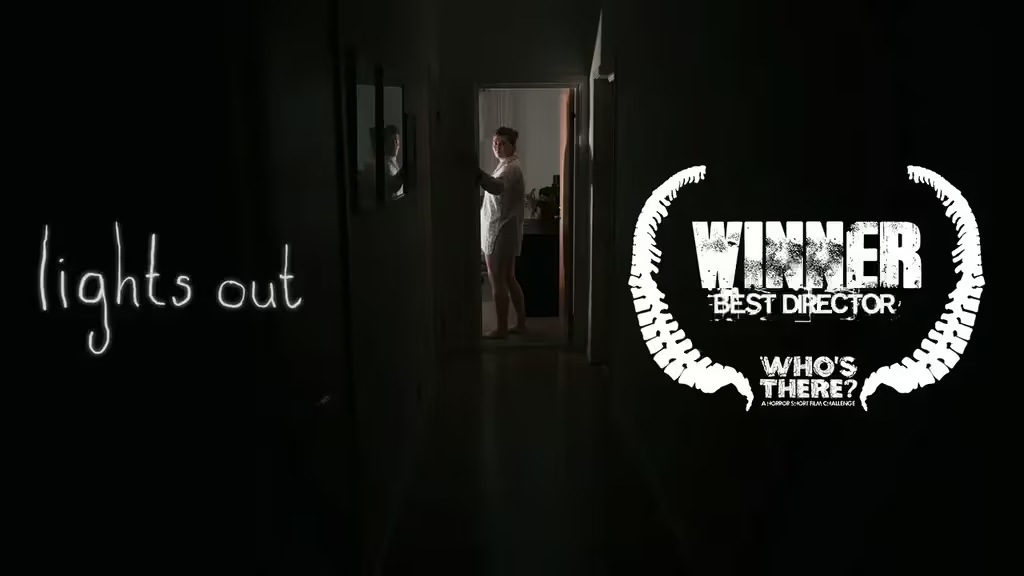
- Bloody Cuts “Who’s There?” Horror Short Film Challenge (2013): It was a finalist, and Sandberg won Best Director. A Vice interview notes the short did not win best film, yet went viral.
- FANT Bilbao 2014: It won Best Short.
- Other awards: A film-series page says it has won a number of short horror awards, including the 2013 Who’s There Film Challenge. Verify any specific award before citing it, because sources are not consistent.
- Cultural impact: The short kicked off Sandberg’s Hollywood career by gaining enough acclaim to warrant studio interest in a feature.
The Origin Story
The film began as an entry in a UK horror challenge. Back in 2013, the British horror production company Bloody Cuts held the “Who’s There?” Short Film Challenge, and Sandberg made the film at home with his wife.
Neither of them expected a career from it. Sandberg told Vice they had no intention of ever turning it into a feature. The film sat at around a thousand views until, a couple of months after the contest, it exploded online. He described refreshing the page while it crossed a million views, then receiving emails from agents, managers, producers and studios.
One account says it was shot in his apartment with a Canon camera, but I could not verify the equipment, so treat that detail as secondhand. The core fact, an apartment shoot with two people and no budget, is well documented.
Visual Style
The film is built on restraint. A No Film School analysis points out that it contains only 13 separate shots, uses a three-act structure in a couple of minutes, and focuses on one core idea: when the lights go out, a monster appears. The setting is a single hallway, and the lighting is the effect. The same analysis notes that Sandberg uses spine-chilling sound sparingly, often using silence and music only at key moments.
An IMDb reviewer says the scares come from anticipation, not gore or loud noises. Because the monster is a silhouette seen only in darkness, the film asks the viewer to supply the details.
Key Themes
- Fear of the dark. The film turns a universal childhood fear into a rule-based threat.
- The unseen presence. What you cannot see is more frightening than what you can.
- Safety and its limits. Light is the only protection, which means the moment you try to rest becomes the moment of greatest danger.
- Domestic space made hostile. A bedtime routine in one’s own home becomes the setting for fear.
- Pure, primal horror. A film-craft site notes it proves you can be primal and scary in a little over two minutes.
Critical Reception
The reception is overwhelmingly positive and largely audience-driven. IMDb users rate it 7.6/10. Reviewers praise its economy, with one calling it a triumph of concise, high-impact horror. A horror blogger said she became a fan and found herself dreading touching the light switch. A film-craft article describes it as hitting all 15 story beats “like clockwork” in two minutes. The viral reach also drew the attention of producer James Wan, who liked the short but wanted to see a treatment before backing a feature, according to Wikipedia.
The 2016 feature was a commercial success, earning $148 million globally. A common criticism is that the original’s tight simplicity is harder to match at feature length, which is a fair reason to start with the short.
Where to Watch
- Free: Sandberg’s official Vimeo and YouTube uploads.
- IMDb and film databases: For credits and ratings.
- The feature: The 2016 Lights Out is available through the usual rental and streaming services, which vary by region.
Director’s Journey
David F. Sandberg was born on 21 January 1981 in Jönköping, Sweden, and began as a YouTube filmmaker releasing no-budget horror under the name “ponysmasher.” After Lights Out went viral, he directed the 2016 feature, then Annabelle: Creation (2017), Shazam! (2019), Shazam! Fury of the Gods (2023) and the 2025 film adaptation of Until Dawn. He also voiced Mister Mind at the end of Shazam!
He still makes shorts on the side, and he runs a production company, Mångata, with Losten. His path is often cited as proof that a good idea and a clear rule can do more than a big budget. The Shazam! director’s own summary: he is “just a guy who made a two-minute short in my apartment,” according to a paraphrased profile.
FAQ
- Who directed the Lights Out short? David F. Sandberg.
- Who plays the woman? Lotta Losten, his wife.
- How long is it? Under three minutes.
- Did it win the contest? No. It was a finalist, and Sandberg won Best Director at the Who’s There? challenge.
- Is the movie the same? The 2016 feature expands the idea with new characters. It is based on the short.