


Made a film but don’t know where to send it? Discover the best student film festivals in 2026 — free & paid submissions, global & local, with insider tips to win.
Student Film Festivals in 2026 — Where to Submit Your Film
Explore the top student film festivals in 2026 — deadlines, submission fees & what judges look for. The ultimate guide for emerging filmmakers ready to showcase their work.
Here’s a 2026-complete guide to student film festivals—what they are, where to submit, how to plan, and how to maximize the impact of your student shorts.
Student Film Festivals Quick overview (2026 at a glance)
- Global “big two” for students:
- Student Academy Awards (Oscars): Open March 2–April 26, 2026; ceremony in September. Categories: Narrative, Documentary, Animation, Alternative/Experimental. Free to enter; cash prizes up to $5,000.
- BAFTA Student Awards: University-only submissions; categories include animation, documentary, live action, games, and immersive; finalists flown to Los Angeles; 2026 submissions are closed, but this is a recurring annual program.
- Major student-only festivals (verified 2026 dates):
- Sehsüchte International Student Film Festivals (Potsdam): April 22–26, 2026; submissions via Festhome/FilmFreeway; no submission fee; open to students worldwide.
- STIFF – Student International Film Festival (Rijeka, Croatia): Nov 25–28, 2026; deadline May 15, 2026; films up to 60 min; completed after Jan 1, 2024; theme “Glitches.”
- Kyoto International Student Films & Video Festival (KISFVF): Feb 20–23, 2026 in Kyoto; long-running Asian student showcase.
- La Cinef (Cannes’ student selection): Registration deadline Feb 15, 2026; films from film schools, fiction or animation, ≤60 min, made within 18 months of the Festival; not accepting documentaries.
- Kinds of festivals you’ll encounter:
- Student-only (often via your school).
- Major general festivals with student categories (e.g., IDSFFK Campus Films, and many shorts fests).
- High-end competitions (Student Academy Awards, BAFTA Student Awards, La Cinef).
Map of the 2026 student festival world
Student Film Festivals; This diagram shows the main pathways and festival types you can choose in 2026:
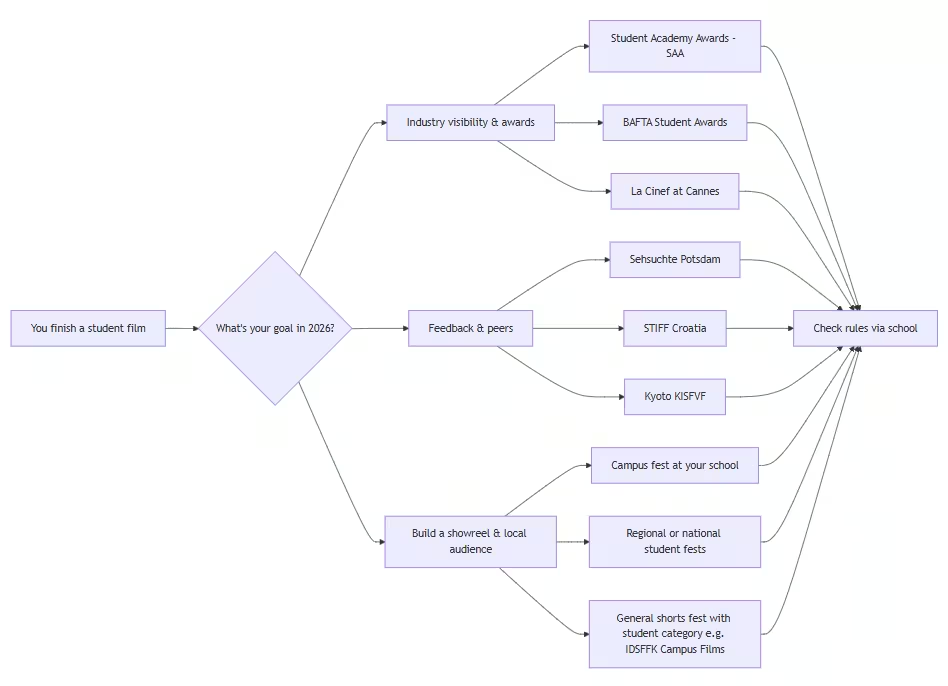
1. What counts as a “student film festivals” in 2026?
Student Film Festivals; In practice, you’re dealing with:
- Student-only festivals: The entire program (or a major section) is restricted to current students and recent graduates. Often open via schools, but some accept direct submissions. Examples: Sehsüchte, STIFF, Kyoto International Student Films & Video Festival.
- Major short/general festivals with student categories: Broad festivals that have dedicated student or “campus” sections. Example: IDSFFK (Kerala) runs a Campus Films competition for student-produced shorts (≤20 min) from institutions in Kerala.
- Prestigious student competitions tied to big institutions:
- Student Academy Awards (Oscars’ global student competition).
- BAFTA Student Awards (BAFTA’s global student showcase, with universities submitting projects).
- La Cinef (Cannes’ Official Selection for film-school films).
2. Top-tier global student competitions (2026)
Student Academy Awards (SAA) – The Oscars’ student competition (US)
- What it is: The Academy’s global student film festivals competition, with four categories: Narrative, Documentary, Animation, Alternative/Experimental.
- 2026 dates:
- Competition opens: March 2, 2026.
- Competition closes: April 26, 2026.
- Awards ceremony: September 2026.
- Prizes: Gold, Silver, and Bronze in each category; cash grants $5,000 / $3,000 / $2,000 respectively.
- Key eligibility rules (2026):
- Directors must be post-secondary students (full-time or part-time) enrolled in a degree/certificate program when the film was made. High school/secondary students are not eligible.
- Only undergraduate intermediate/capstone films, or graduate intermediate/thesis films are eligible; for associate/certificate programs, only final projects qualify.
- Film must be made as part of coursework or a graduation requirement and ≤40 minutes including credits.
- Must be completed between May 19, 2025 and April 26, 2026, and within one year of graduation. No works-in-progress; film cannot be altered after submission.
- Must be in English or subtitled/dubbed in English; finalists must have English closed captions; films must not display festival laurels or awards on-screen.
- Music videos, TV/web episodes, ads, and works-for-hire are not eligible.
- Practical notes: You submit directly via FilmFreeway (YouTube/Vimeo embeds) and must provide a faculty advisor’s contact for verification. Entry is free.
BAFTA Student Awards – UK/US global student competition
- What it is: BAFTA’s annual global competition for students in film, games, and immersive content. BAFTA members vote across categories, and finalists are invited to Los Angeles.
- Categories: Animation, Documentary, Live Action, Games, and Immersive. Longlists (30 shorts in film categories; 10 in games/immersive) are announced, then finalists (3 per category).
- Submission model (important): BAFTA invites over 800 schools and only accepts submissions from authorized university representatives—not directly from students. There is a $35/project fee, with a formal fee-waiver process.
- 2026 status: BAFTA notes “Submissions are now closed for the 2026 BAFTA Student Awards,” with guidance to refer to the 2026 Rulebook for next-cycle planning.
- Takeaway: If your school participates, work with your faculty liaison early; if not, ask your program to join BAFTA’s contact list.
La Cinef (Festival de Cannes – film schools selection)
- What it is: Official Selection of the Festival de Cannes dedicated to films from film schools (fiction and animation only).
- 2026 rules:
- Films must be made within 18 months preceding the Festival; must not have played at major international festivals; max runtime 60 minutes. Documentaries are not accepted.
- Registration deadline (entry form + upload): February 15, 2026.
- Awards: An international jury awards three prizes with grants: First Prize €15,000; Second €11,000; Third €7,500.
- Eligibility via film schools: Submissions are handled through the “My Account” portal on the Cannes site, and your film school must typically endorse your entry.
3. Major student-only festivals (verified 2026 dates)
Sehsüchte International Student Film Festivals (Potsdam, Germany) – Europe
- 2026 dates: April 22–26, 2026 (55th edition).
- Deadline: Call-for-entries lists January 12, 2026 as the submission deadline; notifications around April 23; event dates April 22–26.
- Scope: One of Europe’s largest student film festivals, open to emerging filmmakers worldwide.
- Requirements snapshot:
- Films must have been completed after Jan 1, 2025 (per Festhome listing; VR has different completion date).
- No premiere requirement; prior festival screenings are allowed.
- No submission fee (though platform fees may apply).
STIFF – Student International Film Festival (Rijeka, Croatia)
- 2026 edition: Nov 25–28, 2026.
- Deadline: May 15, 2026 (via FilmFreeway).
- Eligibility:
- Student-created films or debutant films (first film after film school), up to 60 minutes; genres: fiction, documentary, animation, experimental. Completion after Jan 1, 2024. English or English subtitles required.
- Theme for 2026: “Glitches.” While they accept any genre/theme, they give special attention to films aligned with the theme.
- Awards: Jury awards for Best Fiction, Best Documentary, Best Animation; plus an Audience Award and special mentions across craft roles (directing, cinematography, editing, sound, score, etc.).
Kyoto International Student Films & Video Festival (KISFVF, Japan)
- 2026 event: February 20–23, 2026 in Kyoto (28th edition).
- Profile: Established student festival in Asia; programming includes student works from around the world. (The 2026 call listed a deadline of August 1, 2025 for this edition.)
India – IDSFFK Campus Films (Kerala)
- Festival: 18th International Documentary and Short Film Festival of Kerala (IDSFFK) includes a Campus Films competition for students from institutions above Higher Secondary level in Kerala.
- Campus Films eligibility:
- Short Fiction / Documentary up to 20 minutes.
- 2026 dates:
- Completion window: films completed between May 1, 2025 and April 30, 2026.
- Entry submission period: March 10 to May 10, 2026 (deadline 5:00 PM, May 10, 2026).
- This is a good example of a regional government-backed festival with a dedicated student track; useful if you study in Kerala.
4. Other festivals and where to find more in 2026
Global directories (filter by “Student” category)
- FilmFreeway: Use the Student category filter under Categories; note the curated “Academy Award-qualifying Festivals” page for broader festival opportunities (many have student competitions).
- WFCN: Publishes a “List of Film Festivals 2026” with dates and regions; you can then visit each festival’s site to check for student categories.
- Film Fest Report: Provides 2026 dates for major international festivals (Clermont-Ferrand, Berlinale, Cannes, etc.), some of which run student shorts competitions; always check their rules for student-specific eligibility and premiere requirements.
Representative examples (non-exhaustive)
- Global or regional “general” festivals that sometimes include student categories:
- Clermont-Ferrand International Short Film Festival (France): Jan 30–Feb 7, 2026.
- Tampere Film Festival (Finland): March 4–8, 2026.
- Many festivals on the WFCN and Film-Fest-Report lists have student or youth sections; verify by checking each festival’s rules.
- Student-focused but with more limited eligibility:
- ImagiNation International Student Film Festivals (India): school-level through college students; max 25 minutes; 2026 event June 25–26; submissions opened Nov 1, 2025; deadlines Dec 31, 2025 (earlybird), Feb 10, 2026 (regular), March 23, 2026 (extended). Note: this listing is marked “Entries Closed,” so check the festival’s site directly for updates.
5. 2026 planning calendar (student filmmaker view)
Student Film Festivals; A simple month-by-month view (northern-hemisphere academic calendar) can help you spot when to aim for which kind of festival:
- January–February 2026
- Submit to any festivals with winter deadlines (check FilmFreeway, WFCN, and each festival’s site).
- Some student competitions in Asia or winter festivals announce selections or hold events around now (e.g., Kyoto KISFVF ran Feb 20–23).
- La Cinef (Cannes) registration deadline Feb 15, 2026.
- March–April 2026
- Sehsüchte (Potsdam): April 22–26, 2026; submissions due earlier (Jan 12, 2026 per call).
- Student Academy Awards: Open March 2; close April 26, 2026. Plan your final cuts, subtitles, and faculty verification now.
- IDSFFK Campus Films: March 10–May 10, 2026 submission window; aim for earlier submissions to avoid last-minute issues.
- May–June 2026
- STIFF Croatia submission deadline is May 15, 2026; festival in late November.
- IDSFFK (Kerala) Campus Films deadline May 10, 2026; festival held in June.
- Many general short festivals announce student categories around this window; use directories to discover more.
- July–September 2026
- Student Academy Awards ceremony is in September 2026.
- This is a good period to research BAFTA Student Awards for the next cycle and ask your school to join BAFTA’s contact list.
- October–December 2026
- STIFF 2026 runs Nov 25–28 in Rijeka; start planning your 2027 projects with this and similar fests in mind.
- Begin your “festival strategy” for your next films: identify major competitions (SAA, BAFTA, La Cinef) and back-calculate their deadlines so you schedule production, post, and clearance work accordingly.
6. Submission strategy: how to choose the right festivals
- Clarify your goals for 2026
- Visibility vs. feedback: Prestigious student competitions (SAA, BAFTA, La Cinef) give industry visibility and prizes; student-only fests and campus sections often offer strong peer networking and feedback.
- Region vs. global: If you want local audiences, prioritize regional/national student fests (IDSFFK Campus Films, national student competitions, and school showcases).
- Type of film: Animation and documentary-focused student fests may treat films differently than narrative-heavy programs; always check category eligibility (e.g., La Cinef does not accept documentaries).
- Always read the rules
- Student status: Some fests restrict to currently enrolled students; others allow recent graduates (e.g., STIFF accepts “debutant films” as well as student films).
- Completion date and premiere requirements: For example, IDSFFK Campus Films requires completion between May 1, 2025 and April 30, 2026. La Cinef requires films made in the 18 months preceding the Festival and not previously shown at major international festivals.
- Runtime limits: SAA max 40 minutes; La Cinef max 60; STIFF up to 60; IDSFFK Campus up to 20.
- Language/subtitles: SAA requires English or English subtitles/dub; finalists need English captions. STIFF and many others require English subtitles if not in English.
- Work with your school early
- BAFTA Student Awards and some university-linked festivals require submission through authorized faculty reps, not individual students. Ask your program’s coordinator/film office if your school is invited or can join.
- SAA requires a faculty advisor’s name and email for verification; coordinate early and keep them informed of deadlines.
- La Cinef and many other school-linked competitions expect submissions routed through or endorsed by the film school; confirm your school’s internal process.
- Budget your fees and time
- Some student fests (e.g., Sehsüchte) have no submission fee; others charge modest fees. Platforms like FilmFreeway may add processing fees.
- Aim for early-bird deadlines to save money and avoid technical issues; always double-check notification and festival dates before paying.
7. Preparing your film and materials
- Technical basics:
- Provide a high-quality screening file (as required by the festival). Many prefer online screeners (IDSFFK explicitly notes only online screeners for preview).
- Ensure correct aspect ratio, reliable sound mix, and accurate color grading for a professional impression.
- Subtitles and accessibility:
- English subtitles are almost mandatory if your film is not in English (and sometimes even if it is). SAA also encourages English closed captions; finalists must have them.
- Check festival rules about burned-in subtitles vs. closed caption files; some specify.
- Legal clearances:
- Clear rights for music, stock footage, images, and any recognizable people or brands. Many festivals explicitly require you to certify you hold these rights (e.g., INISFF rules).
- Do not display festival laurels or award logos on the film for competitions like SAA; they prohibit laurels in the submitted copy.
- Festival package:
- Prepare: synopsis (short and long), director’s statement, bio, headshots, stills from the film, poster, and trailer (if you have one). Keep these on hand.
- Be honest about runtime and completion date—discrepancies can lead to disqualification (some fests, like IDSFFK, specify strict completion windows and may require affidavits).
8. After you submit: how to make the most of it
- If you’re selected:
- Attend if you can. Student fests are valuable networking hubs (Sehsüchte, STIFF, KISFVF, IDSFFK, BAFTA finalists events).
- Participate in Q&As and side events; many festivals organize workshops and panels for students (STIFF explicitly mentions post-screening discussions and workshops).
- Connect with other filmmakers and jurors; follow up with a brief, polite email after the festival.
- If you’re not selected:
- Treat it as data, not judgment. Selection is often about curatorial fit and volume.
- Consider non-premiere or regional fests that might still welcome your film; check whether earlier selections disqualify you (many student fests are more flexible on this than major competitions).
- Keep a festival log:
- Track where you submitted, deadlines, fees, premiere status, and results. This helps you plan smarter for the next film and avoid double-submitting to festivals with conflicting exclusivity rules.
9. Common pitfalls to avoid in 2026
- Missing eligibility fine print: e.g., SAA’s requirement that the film be a course-related intermediate/capstone/thesis project and ≤40 minutes; or BAFTA’s requirement that submissions come via universities, not directly from students.
- Ignoring completion-date windows: festivals like IDSFFK Campus Films and La Cinef are strict on when the film was completed relative to the festival dates.
- Submitting works-in-progress: SAA explicitly says no WIPs and that films cannot be altered after submission; other fests often share this stance.
- Premiere conflicts: high-profile programs like La Cinef require that films have not been presented at major international festivals; always check each program’s rules.
- Formatting and metadata errors: incorrect runtime, missing subtitles, or broken preview links lead to quick rejections; test your online screener before submitting.
10. Your 2026 checklist (copyable)
- Goal-setting: decide whether 2026 is about SAA/BAFTA/Cinef-type visibility, or peer festivals and local exposure.
- Research: Use FilmFreeway (Student filter) and WFCN’s 2026 list to identify festivals; verify student categories on each festival’s site.
- Rules check: For each target festival, confirm:
- Student status & graduation window.
- Completion date window.
- Runtime caps.
- Premiere/exclusivity requirements.
- Language/subtitle rules.
- Submission method (direct vs. via school).
- School coordination: For BAFTA, SAA, La Cinef and school-linked fests, talk to faculty early and submit any internal forms on time.
- Materials: Finish film, English subs, closed captions (if required), and package (synopsis, bio, stills, trailer).
- Schedule: Back-calculate from key deadlines—La Cinef (Feb 15, 2026), SAA (Apr 26, 2026), IDSFFK Campus Films (May 10, 2026), STIFF (May 15, 2026)—to lock your post-production and submission work.
- Submit: Aim for early deadlines where possible; keep records.
- Attend & network: Go whenever you can; participate in festival events and follow up professionally.
- Review: After the 2026 cycle, note what worked (which festivals, what kinds of films), and refine your strategy for 2027.
Student Film Festivals; If you tell me your level (high school vs. undergrad vs. grad), country/region, and the kind of film you’re making or planning, I can build a short, targeted 2026 festival list for you with concrete deadlines and “fit” notes.